skip to main |
skip to sidebar

Burg Hohenwerfen is a castle south of the Austrian city of Salzburg. The castle is majestically surrounded by the Berchtesgaden Alps and the Tennengebirge mountain range. The fortification is a "sister" of Hohensalzburg Castle. Both castles are dated from the 11th century.
It was built between 1075 and 1078 during the Investiture Controversy by the order of Archbishop Gebhard of Salzburg as a strategic bulwark atop a 155 meter rock high above the Salzach valley. In 1931 the fortress, then owned by Archduke Eugen of Austria was severely damaged by a fire and, though largely restored, finally had to be sold to the Salzburg Reichsgau in 1938. After World War II it was used as a training camp by the Austrian Federal Gendarmerie (rural police) until 1987.
Nowadays the bastion, enlarged and renovated several times over the centuries, functions as an adventure castle for its visitors. Among the numerous attractions offered by the fortress are guided tours showing its extensive weapons collection, the historical Salzburg Falconry with the falconry museum as well as a stylish fortress tavern. The historic Falconry Center is a special attraction, offering daily flight demonstrations by various birds of prey.

You might like this, ~A.K.~, the Burg can be seen several times in the background in The Sound of Music, while they are singing Do Re Mi. Neat, huh?
This last picture is the one that made me decide to do a blog post. I took one look at it a literally said in my head, ''Dude epic awesomeness! I wanna own that!''
 Have a wonderful day.

Blarney Castle (Irish: Caisleán na Blarnan) is a medieval stronghold in Blarney, near Cork, Ireland, and the River Martin. Though earlier fortifications were built on the same spot, the current keep was built by the MacCarthy dynasty, Kings of Desmond, and dates from 1446.
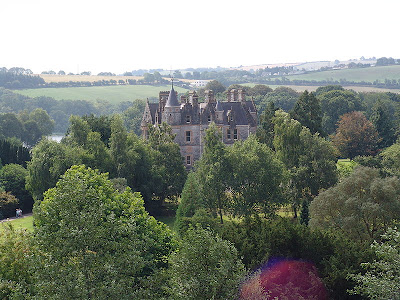
The castle originally dates from before AD 1200, when a wooden structure was built on the site. Around 1210 A.D. this was replaced by a stone fortification. It was destroyed in 1446, but subsequently rebuilt by Cormac Laidir MacCarthy, Lord of Muscry. (Epic name, huh?)

The castle was besieged during the Irish Confederate Wars and was seized in 1646 by Parliamentarian forces under Lord Broghill. However after the Restoration the castle was restored to Donough MacCarty, who was made 1st Earl of Clancarty.
During the Williamite War in Ireland in the 1690s, the then 4th Earl of Clancarty (also named Donough MacCarty) was captured and his lands (including Blarney Castle) were confiscated by the Williamites.
The castle was sold and changed hands a number of times before being purchased by Sir James St. John Jefferyes.
Members of the Jefferyes family later built a mansion near the keep. This house was destroyed by fire however, and in 1874 a replacement baronial mansion - known as Blarney House - was built overlooking the nearby lake.

Well, there is one thing that is always mentioned every time someplace is talking about Blarney Castle. And that is the Blarney Stone. I would really rather not talk about that (Not a pun.) (You will get that statement after you read about the Stone.), but you can read about it here: http://www.travelsinireland.com/castle/blarney.htm

You can read more about Blarney Castle here:
http://www.blarneycastle.ie/history

Dea-lá (Good day.)
I don't think I ever seen a castle quite like this one. Not that I've ever seen any castles, but never seen pictures of a castle quite like this one.

Mir Castle, also called the Mirsky Castle Complex, is located in the town of Mir (How ironic.) in the Karelichy District, Belarus.
You can read about it at
http://www.data.minsk.by/history/mir/

добры дзень
So, lately I've been doing a lot of Chateaus and Fairytale Castles, which are all nice and good in their own way, but I wanted something different. Like a old stone ruin castle, a castle that actually looked like It'd seen some action. A real he-castle.
Okay, okay, it got creamed in a lightning storm, BUT IT LOOKS COOL!

I'm speaking of Kilchurn Castle, Loch Awe, in Argyll and Bute, Scotland. It was built in about 1450 by Sir Colin Campbell, first Lord of Glenorchy, as a five story tower house with a courtyard defended by an outer wall. By about 1500 an additional range and a hall had been added to the south side of the castle.
Further buildings went up during the 16th and 17th centuries. Kilchurn was on a small island in Loch Awe scarcely larger than the castle itself, although it is now connected to the mainland as the water level was altered in 1817. The castle would have been accessed via an underwater or low lying causeway.
At the turn of the 16th century Kilchurn Castle was extended by Sir Duncan Campbell with the addition of a single story dining hall built along the inside of the south curtain. During the second half of the century, another Sir Colin Campbell, the 6th Laird, continued to improve the castle's accommodation by adding some chambers to the north of the tower house, and remodeling the parapet. This included the introduction of the circular corner turrets adorned by corbels, most of which have survived remarkably well.
 Engraving of Kilchurch Castle by William Miller, 1846
Towards the end of the 16th century the Clan MacGregor of Glenstrae were occupying the castle. Once owning the lands of Glenorchy during the 14th century, until they passed through marriage to the Campbells, the MacGregors were appointed keepers to Kilchurn Castle as the Campbells spent much of their time at Fincharn.
This arrangement lasted until the very early part of the 17th century, when a violent feud between the two families brought it to an end and the Campbells retook possession. In 1681 Sir John Campbell of Glenorchy was made 1st Earl of Breadalbane. To take advantage of the turbulence of the times, he converted Kilchurn into a modern barracks, capable of housing 200 troops. His main addition was the three story L-shaped block along the north side.
In 1760 the castle was badly damaged by lightning and was completely abandoned; the remains of a turret of a tower, still resting upside-down in the center of the courtyard, attest to the violence of the storm. I wasn't kidding.
The ruin is currently in the care of Historic Scotland, and is open to the public during the summer.
 Math latha.
I hate realizing on Tuesday that tomorrow is Wednesday. But it almost always happens that way. It was late in the afternoon, almost 4:00 to be exact. My sister, Kae, would be coming home soon, and probably would be wanting her computer. I was hurriedly typing in the password to her computer and I thought, "Scotland!" I haven't done a post on a castle in Scotland! And I love Scotland! This had to be remedied. Soon. Now.
 (So, whatchya think?)
Craigievar Castle is located six miles south of Alford, Aberdeenshire, Scotland. It was owned by Clan Sempill. An excellent example of the original Scottish Baronial architecture, the great seven-storey castle was completed in 1626 by the Aberdonian merchant William Forbes, ancestor to the "Forbes-Sempill family" and brother of the Bishop of Aberdeen. Forbes purchased the partially completed structure from the impoverished Mortimer family in the year 1610.

Forbes family resided here for 350 years until 1963, when the property was gifted to the National Trust for Scotland.

The castle originally had more defensive elements including a walled courtyard with four round towers; only one of the round towers remains today. In the arched door to that round tower are preserved the carved initials of Sir Thomas Forbes, William Forbes' son. There was also a massive iron yett or gate covering the entrance door.
.jpg)
You can read more about the place at:
http://www.aboutaberdeen.com/craigievarcastle.php
So, I find it a truly lovely castle, though, a wee bit Fairytale for me to like it 100%. But I do think it is wonderful.

Math latha. Scottish, good day.

Fortresses in their own way, leveled in battle as many before them. Yet seldom before has an act of war been so grievous.
Remember them.


 Math latha


.jpg)


